
by Gabriela Milián Calzadilla
Sometimes, in order to move forward, it is necessary to retrace the path. Man knows it; the artist knows it. In that eagerness, Back to the village, the most recent recording by Cuban composer and pianist Ernesto Oliva (Guantánamo, 1988), crystallizes a poetics that understands return as a synonym of movement. The constant coming and going of a soundscape runs between rhythmic patterns, interpretative gestures and ways of saying; between formal structures treated with elegant skill and a chamber conception of the repertoire. The village, more than a place, becomes a matrix from which the musical discourse acquires order and radiates its influence towards other geographies.
Conceived as audiovisual, Back to the village is the result of collective work. Here converge wills that conceive creation also as a process of accompaniment. The Fondo de Arte Joven (FAJ), a cultural platform founded in 2023 in the heat of the 38th edition of Jazz Plaza, whose Creation Grant -granted to Ernesto Oliva in 2024- made viable the materialization of the phonogram, which bet on the validation of a sound thesis whose core lies in the expansion of languages and the responsibility of artistic work. This bet found a correlate in the high quality of a production recorded live at Abdala Studios, a space capable of assuming, with technical solvency, the complexity of the challenge.
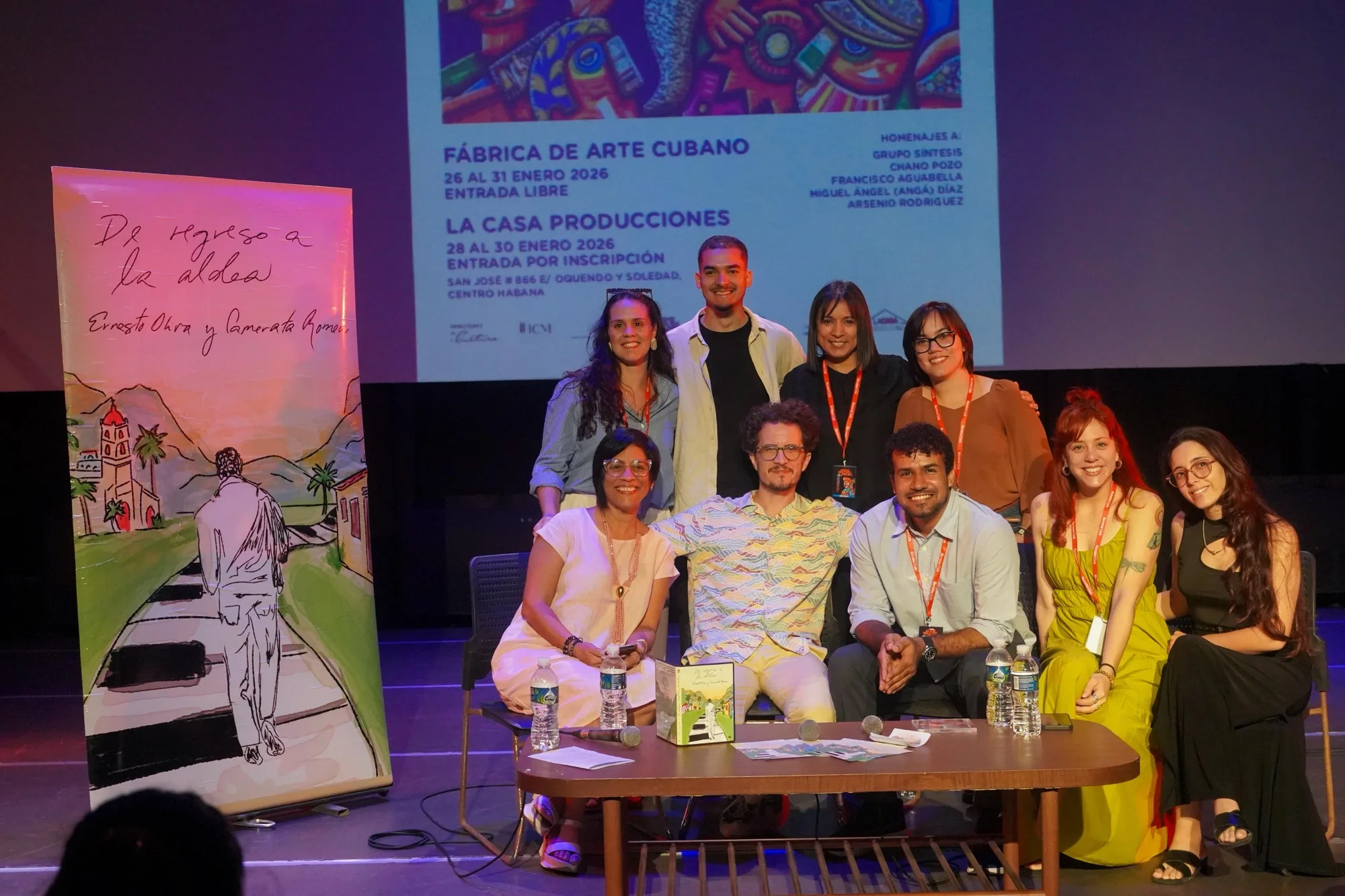
As part of the 41st edition of the Jazz Plaza International Festival and the 21st edition of its International Colloquium «Leonardo Acosta in Memoriam» the DVD Back to the village was presented on January 26 at the Fábrica de Arte Cubano, in a panel dedicated to the exchange on contemporary musical creation. The festival -a space of convergence where jazz broadens its stylistic contours to dialogue with diverse traditions, memories and musical writings- offered the propitious context to place the proposal in a larger framework: that of the musics that assume their relationship with the autochthonous without renouncing to their universal vocation.


Oliva's work is placed at that crossroads, and his catalog sustains the tension that emanates from his homeland and his academic training, essential pillars of his creation. His intervention allowed an approach to the motivations and decisions that nurture the project, while the voices of Lorenzo Suarez, founder and Strategic Advisor of the FAJ, and musicians Olivia Rodriguez (double bass) and Jesus Estrada (percussion), provided complementary views from the cultural management and interpretive praxis. Under the moderation of musicologist Neris González Bello -president of the Colloquium and of Bis Music, whose label accompanies this issue- the exchange highlighted the importance of maintaining spaces of mediation where music is contextualized, problematized and recorded as an act of socialization of a creative process that links thought and experience.
The story told by its protagonists made it possible to understand in this DVD the continuity of My village (Egrem, 2020), Ernesto Oliva's first phonogram conceived as an explicit homage to Guantánamo and to the universes that have shaped his musical imaginary. If that work started from piano writing to unfold in the quartet format, Back to the village is expanded through the incorporation of an extended format that integrates the Camerata Romeu, an emblematic group of the island's orchestral sphere, recognized for its interpretative rigor, under the direction of maestro Zenaida Romeu. The decision responded to an expressive need. The timbre expansion favored the re-reading of traditional genres -changüí, nengón, kiribá-, articulated with contemporary compositional procedures and with a string writing that directly refers to concert music.
In Ernesto Oliva's hands, the piano - historically alien to the territories of Guaso - ceases to be a black-tie guest and becomes a chronicler of the village. Without imposing its concertante weight, it acts as a mediator that transcribes the rhythmic patterns of the tres to the keyboard by means of a writing attentive to the inheritance. A percussion set specially designed to reconstruct the Guantanamo soundscape is added to this narrative: textures and accents that evoke the pulse of the land and the acoustic memory of the environment. Within this plot, the Camerata Romeu does not assume a secondary role, nor does it operate as a «harmonic mattress». The orchestra is involved. It is, in itself, a great expressive mass that intends the musical story. The consequence: a thought that assumes hybridity as the first condition of the Cuban being.
The titles that make up Back to the village articulate a system of references that precedes and orients listening. In them operates a very specific way of naming where everyday speech, the memory of the eastern region and wit activate specific emotions, recognizable from the first enunciation. Expressions such as Café changüiao, Sonengueao o Son del guateque situate the experience of gender as social practices. Other titles -Chipa’ e tren, Kiribañingo- condense, from their own sonority, rhythmic and gestural impulses that refer to a certain corporeality of music, closer to the sensorial memory than to the literalness of its meaning.
In a different register, Pa’ Pastorita a guarareaux?, inspired by Roberto Baute's work of the same name, introduces a game of intertextual allusions, while Pa’ ti and Interludio...and your rain They shift the focus to an intimate, overwhelming writing, as if they wanted to confess past, present or future loves. The journey ends with Canenga?, The title is an open interrogation that returns music to its playful and participatory dimension. Rather than concluding the discourse, the title invites to exchange and keeps the answer in suspense, inviting to prolong the sound experience.


The concert premiere took place on January 31 at the Basílica Menor del Convento de San Francisco de Asís. The architecture of the space -its stone, its height, its memory- welcomed a meeting that progressed unhurriedly, guided by the words of Ernesto Oliva himself, who traced, between work and work, the emotional map that gave rise to the project. Each explanation, each thanks, each memory, narrowed the distance between stage and audience, until listening became an act of complicity.
The twelve pieces of the album were then deployed in their entirety and there the return took the form of a performative gesture: the audience responded, called, accompanied, became participative, retaking the mood of the original recording. Music recovered its original condition as a social act, as an event that takes place between bodies and not only in front of them.
That spirit found one of its most moving images shortly before the closing, with a miniature that Ernesto usually introduces in his presentations and that derived from the exercises written for his students. The little cowbell -the title of the work- demands that someone uninitiated in the art of piano playing dares to go on stage to imitate, according to the composer's indications, the rhythm of the percussion instrument. Fidel Camilo Torres Fernández, the brave child who played for the audience that night, embodied the most honest dimension of the gesture. The closeness of the two - stripped of all spectacularity - condensed the profound meaning of the village; to return to it is to return home. And to do so through music implies opening it so that others may enter, listen and -even if only for an instant- recognize it as their own.
 English
  Español
  Français
  Deutsch
  Italiano